이코에코(Eco²) Clean Architecture #12: Locaton 도메인 마이그레이션

domains/location Layered → apps/location Clean Architecture 전환
AI Assistant: Claude Opus 4.5 (Anthropic)
작업 일자: 2026-01-05
1. 마이그레이션 배경
1.1 기존 구조 (domains/location)
domains/location/
├── api/v1/endpoints/
│   ├── location.py          # HTTP 엔드포인트
│   └── metrics.py
├── services/
│   ├── location.py          # ~300줄, 조회 + 변환 + 정책
│   ├── category_classifier.py
│   └── zoom_policy.py
├── repositories/
│   └── normalized_site_repository.py
├── models/
│   └── normalized_site.py
└── clients/
└── redis_cache.py # Redis 캐시 의존문제점:
| 문제 | 설명 |
|---|---|
| 책임 혼재 | LocationService가 조회, 변환, 정책을 모두 담당 |
| 구현체 의존 | Service가 Repository 구현체에 직접 의존 |
| 테스트 어려움 | 인프라 구현체에 직접 의존 → Mock 불가 |
1.2 마이그레이션 목표
| 목표 | 방법 |
|---|---|
| 계층 분리 | Domain, Application, Infrastructure, Presentation |
| 의존성 역전 | Port/Adapter 패턴으로 외부 의존성 추상화 |
| 테스트 용이성 | Port 기반 Mock 주입 가능 |
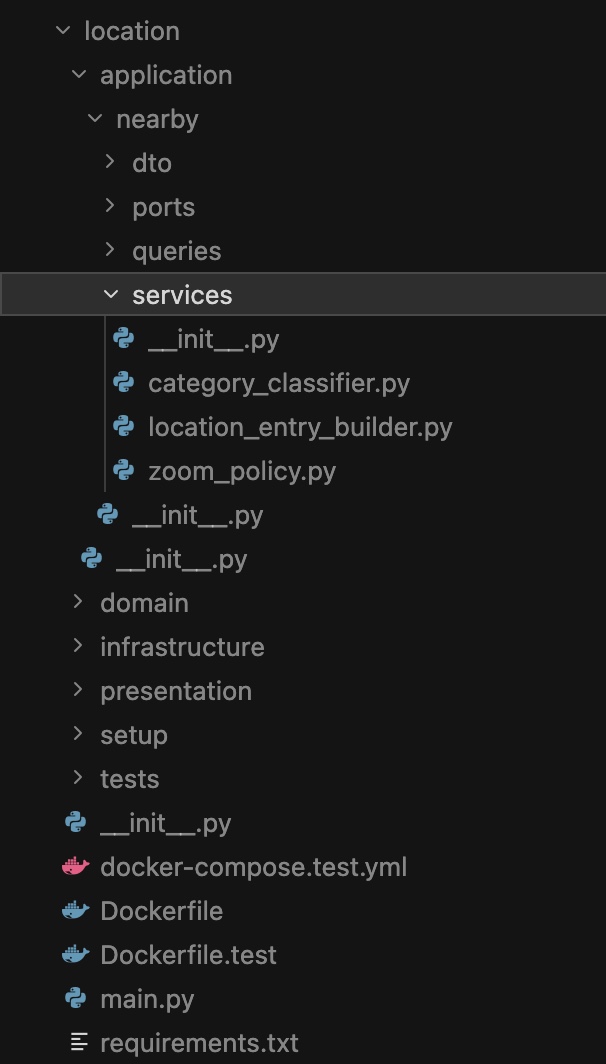
2. 최종 폴더 구조
apps/location/
├── domain/
│   ├── entities/
│   │   └── normalized_site.py    # NormalizedSite 엔티티
│   ├── enums/
│   │   ├── store_category.py     # StoreCategory
│   │   └── pickup_category.py    # PickupCategory
│   └── value_objects/
│       └── coordinates.py        # Coordinates VO
├── application/
│   └── nearby/
│       ├── dto/
│       │   ├── location_entry.py    # LocationEntry DTO
│       │   └── search_request.py    # SearchRequest DTO
│       ├── ports/
│       │   └── location_reader.py   # LocationReader Port
│       ├── services/
│       │   ├── zoom_policy.py           # ZoomPolicyService
│       │   ├── category_classifier.py   # CategoryClassifierService
│       │   └── location_entry_builder.py # LocationEntryBuilder
│       └── queries/
│           └── get_nearby_centers.py    # GetNearbyCentersQuery
├── infrastructure/
│   └── persistence_postgres/
│       ├── models.py                    # ORM 모델
│       └── location_reader_sqla.py      # SqlaLocationReader
├── presentation/
│   └── http/
│       ├── controllers/
│       │   ├── health.py         # 헬스 체크
│       │   └── location.py       # /locations/centers
│       └── schemas/
│           └── location.py       # Pydantic 응답
├── setup/
│   ├── config.py
│   ├── database.py
│   └── dependencies.py           # DI 설정
├── main.py
└── tests/
3. 계층별 설계
3.1 Domain Layer
도메인 계층은 외부 의존성 없이 순수 비즈니스 객체만 포함합니다.
# domain/entities/normalized_site.py
@dataclass(frozen=True)
class NormalizedSite:
    """정규화된 위치 사이트 엔티티."""
    id: int
    source: str
    source_key: str
    positn_nm: Optional[str] = None
    positn_pstn_lat: Optional[float] = None
    positn_pstn_lot: Optional[float] = None
    # ... 영업시간, 주소 등 20+ 필드
    metadata: dict[str, Any] = field(default_factory=dict)

    def coordinates(self) -> Optional[Coordinates]:
        """좌표 Value Object 반환."""
        if self.positn_pstn_lat is None or self.positn_pstn_lot is None:
            return None
        return Coordinates(
            latitude=self.positn_pstn_lat,
            longitude=self.positn_pstn_lot
        )
설계 판단:
| 판단 | 근거 |
|---|---|
frozen=True |
Entity지만 조회 전용이므로 불변으로 설계 |
coordinates() 메서드 |
좌표 유효성 검증 후 VO 반환 — null 안전성 |
metadata 필드 |
소스별 확장 데이터를 유연하게 저장 |
# domain/value_objects/coordinates.py
@dataclass(frozen=True)
class Coordinates:
    """위도/경도 Value Object."""
    latitude: float
    longitude: float
# domain/enums/store_category.py
class StoreCategory(str, Enum):
REFILL_ZERO = "refill_zero" # 제로웨이스트샵
CAFE_BAKERY = "cafe_bakery"
VEGAN_DINING = "vegan_dining"
UPCYCLE_RECYCLE = "upcycle_recycle"
PUBLIC_DROPBOX = "public_dropbox" # 무인 수거함
GENERAL = "general"3.2 Application Layer
Application 계층은 Use Case를 오케스트레이션합니다. Port를 통해 Infrastructure에 의존하지 않습니다.
계층 구성 원칙
┌─────────────────────────────────────────────────────────┐
│  Application Layer                                       │
│                                                          │
│  ┌────────────┐  ┌────────────┐  ┌────────────────────┐ │
│  │    DTO     │  │  Service   │  │   Query/Command    │ │
│  │ (데이터전달)│◄─│ (순수로직) │◄─│  (오케스트레이션)  │ │
│  └────────────┘  └────────────┘  └─────────┬──────────┘ │
│                                            │             │
│                                            ▼             │
│                                  ┌────────────────────┐ │
│                                  │       Port         │ │
│                                  │   (인터페이스)     │ │
│                                  └────────────────────┘ │
└─────────────────────────────────────────────────────────┘
                                            ▲
                                            │ implements
                              ┌─────────────┴─────────────┐
                              │      Infrastructure       │
                              │        Adapter            │
                              └───────────────────────────┘
구성 요소 역할:
| 구성 요소 | 역할 | 예시 |
|---|---|---|
| DTO | 계층 간 데이터 전달 | LocationEntry, SearchRequest |
| Service | 순수 비즈니스 로직 | ZoomPolicyService, CategoryClassifierService |
| Query | Use Case 오케스트레이션 | GetNearbyCentersQuery |
| Port | 외부 시스템 추상화 | LocationReader |
Port 정의
# application/nearby/ports/location_reader.py
class LocationReader(ABC):
    """위치 데이터를 읽기 위한 Port."""

    @abstractmethod
    async def find_within_radius(
        self,
        *,
        latitude: float,
        longitude: float,
        radius_km: float,
        limit: int = 100,
    ) -> Sequence[Tuple[NormalizedSite, float]]:
        """반경 내 위치 사이트와 거리(km)를 반환."""
        raise NotImplementedError

    @abstractmethod
    async def count_sites(self) -> int:
        """총 사이트 수를 반환."""
        raise NotImplementedError
Service 구현
Service는 순수 로직만 담당하며, Port에 의존하지 않습니다.
# application/nearby/services/zoom_policy.py
class ZoomPolicyService:
    """줌 레벨에 따른 검색 반경 및 결과 제한 정책."""

    ZOOM_RADIUS_TABLE = {
        1: 80000,   # 카카오맵 14 (세계) → 80km
        14: 800,    # 카카오맵 1 (거리) → 800m
        # ...
    }

    @staticmethod
    def radius_from_zoom(zoom: int | None) -> int:
        """줌 레벨에 따른 검색 반경 (미터) 반환."""
        if zoom is None:
            return 5000  # 기본값 5km
        normalized = ZoomPolicyService._normalize_zoom(zoom)
        return ZOOM_RADIUS_TABLE.get(normalized, 5000)

    @staticmethod
    def _normalize_zoom(zoom: int) -> int:
        """카카오맵 줌 레벨을 내부 스케일로 변환."""
        # 카카오맵: 1(확대) ~ 14(축소)
        # 내부: 1(축소) ~ 20(확대)
        clamped = max(1, min(zoom, 14))
        ratio = (14 - clamped) / 13
        return int(1 + (19 * ratio) + 0.5)
# application/nearby/services/category_classifier.py
class CategoryClassifierService:
"""위치 사이트의 카테고리를 분류하는 서비스."""
STORE_PATTERNS = [
StoreCategoryPattern(
StoreCategory.REFILL_ZERO,
("제로웨이스트", "리필", "무포장"),
),
StoreCategoryPattern(
StoreCategory.CAFE_BAKERY,
("카페", "커피", "베이커리"),
),
# ...
]
@staticmethod
def classify(
site: NormalizedSite,
metadata: Mapping[str, Any] | None = None,
) -> tuple[StoreCategory, list[PickupCategory]]:
"""사이트 정보를 기반으로 카테고리 분류."""
store = CategoryClassifierService._classify_store(site, metadata or {})
pickup = CategoryClassifierService._classify_pickup(metadata or {})
return store, pickup# application/nearby/services/location_entry_builder.py
class LocationEntryBuilder:
"""NormalizedSite → LocationEntry DTO 변환."""
WEEKDAY_LABELS = (
("mon_sals_hr_expln_cn", "월"),
("tues_sals_hr_expln_cn", "화"),
# ...
)
TZ = ZoneInfo("Asia/Seoul")
@staticmethod
def build(
site: NormalizedSite,
distance_km: float,
metadata: dict[str, Any],
store_category: StoreCategory,
pickup_categories: list[PickupCategory],
) -> LocationEntry:
"""도메인 엔티티를 DTO로 변환."""
name = LocationEntryBuilder._first_non_empty(
metadata.get("display1"),
site.positn_nm,
fallback="Zero Waste Spot",
)
operating_hours = LocationEntryBuilder._derive_operating_hours(site)
return LocationEntry(
id=site.id,
name=name,
source=site.source,
road_address=site.positn_rdnm_addr,
latitude=site.positn_pstn_lat,
longitude=site.positn_pstn_lot,
distance_km=distance_km,
distance_text=LocationEntryBuilder._format_distance(distance_km),
store_category=store_category.value,
pickup_categories=[c.value for c in pickup_categories],
is_open=operating_hours.get("is_open"),
is_holiday=operating_hours.get("is_holiday"),
start_time=operating_hours.get("start_time"),
end_time=operating_hours.get("end_time"),
phone=LocationEntryBuilder._derive_phone(site, metadata),
)Query 구현
Query는 Port와 Service를 조합하여 Use Case를 완성합니다.
# application/nearby/queries/get_nearby_centers.py
class GetNearbyCentersQuery:
    """주변 재활용 센터를 조회하는 Query."""

    def __init__(
        self,
        location_reader: LocationReader,           # Port
        zoom_policy_service: ZoomPolicyService,    # Service
        category_classifier_service: CategoryClassifierService,
        location_entry_builder: LocationEntryBuilder,
    ) -> None:
        self._location_reader = location_reader
        self._zoom_policy_service = zoom_policy_service
        self._category_classifier_service = category_classifier_service
        self._location_entry_builder = location_entry_builder

    async def execute(self, request: SearchRequest) -> Sequence[LocationEntry]:
        # 1. 정책 적용: 줌 레벨 → 반경/제한
        effective_radius = request.radius or \
            self._zoom_policy_service.radius_from_zoom(request.zoom)
        limit = self._zoom_policy_service.limit_from_zoom(request.zoom)

        # 2. 데이터 조회: Port를 통해 Infrastructure 접근
        rows = await self._location_reader.find_within_radius(
            latitude=request.latitude,
            longitude=request.longitude,
            radius_km=effective_radius / 1000,
            limit=limit,
        )

        # 3. 변환 및 필터링
        entries: list[LocationEntry] = []
        for site, distance in rows:
            metadata = site.metadata or {}

            # 카테고리 분류
            store_cat, pickup_cats = self._category_classifier_service.classify(
                site, metadata
            )

            # 필터 적용
            if request.store_filter and store_cat not in request.store_filter:
                continue
            if request.pickup_filter:
                if not set(pickup_cats) & request.pickup_filter:
                    continue

            # DTO 변환
            entries.append(
                self._location_entry_builder.build(
                    site=site,
                    distance_km=distance,
                    metadata=metadata,
                    store_category=store_cat,
                    pickup_categories=pickup_cats,
                )
            )

        return entries
Query vs Service 역할 분리:
| 구분 | Query | Service |
|---|---|---|
| 역할 | 오케스트레이션 (흐름 제어) | 순수 비즈니스 로직 |
| 의존성 | Port + Service | 없음 (순수 함수) |
| 테스트 | Port Mock 필요 | Mock 불필요 |
| 변경 빈도 | Use Case 변경 시 | 비즈니스 규칙 변경 시 |
3.3 Infrastructure Layer
Infrastructure 계층은 Port의 구현체(Adapter)를 제공합니다.
# infrastructure/persistence_postgres/location_reader_sqla.py
class SqlaLocationReader(LocationReader):
    """SQLAlchemy를 사용하여 위치 데이터를 읽는 Adapter."""

    def __init__(self, session: AsyncSession) -> None:
        self._session = session

    async def find_within_radius(
        self,
        *,
        latitude: float,
        longitude: float,
        radius_km: float,
        limit: int = 100,
    ) -> Sequence[Tuple[NormalizedSite, float]]:
        try:
            # PostGIS earthdistance 확장 사용
            distance_expr = self._earthdistance_expr(latitude, longitude)
            return await self._execute_query(distance_expr, radius_km, limit)
        except DBAPIError:
            # 확장 미설치 시 Haversine 폴백
            distance_expr = self._haversine_expr(latitude, longitude)
            return await self._execute_query(distance_expr, radius_km, limit)

    @staticmethod
    def _earthdistance_expr(lat: float, lon: float):
        """PostGIS earth_distance 함수 사용."""
        return (
            func.earth_distance(
                func.ll_to_earth(lat, lon),
                func.ll_to_earth(
                    NormalizedLocationSite.positn_pstn_lat,
                    NormalizedLocationSite.positn_pstn_lot,
                ),
            ) / 1000.0
        ).label("distance_km")

    @staticmethod
    def _haversine_expr(lat: float, lon: float):
        """Haversine 공식 (PostGIS 없을 때 폴백)."""
        cosine = func.cos(func.radians(lat)) * func.cos(
            func.radians(NormalizedLocationSite.positn_pstn_lat)
        ) * func.cos(
            func.radians(NormalizedLocationSite.positn_pstn_lot) - func.radians(lon)
        ) + func.sin(func.radians(lat)) * func.sin(
            func.radians(NormalizedLocationSite.positn_pstn_lat)
        )
        clamped = func.least(1.0, func.greatest(-1.0, cosine))
        return (6371.0 * func.acos(clamped)).label("distance_km")

    def _to_domain(self, site: NormalizedLocationSite) -> NormalizedSite:
        """ORM 모델 → 도메인 엔티티 변환."""
        metadata = {}
        if site.source_metadata:
            try:
                metadata = json.loads(site.source_metadata)
            except (TypeError, json.JSONDecodeError):
                pass

        return NormalizedSite(
            id=int(site.positn_sn),
            source=site.source,
            source_key=site.source_pk,
            positn_nm=site.positn_nm,
            positn_pstn_lat=site.positn_pstn_lat,
            positn_pstn_lot=site.positn_pstn_lot,
            # ... 나머지 필드
            metadata=metadata,
        )
Graceful Degradation 패턴:
┌─────────────────────────────────────────────────┐
│  find_within_radius()                           │
│                                                 │
│  try:                                           │
│      PostGIS earth_distance ───────► 빠름, 정확 │
│  except DBAPIError:                             │
│      Haversine fallback ───────────► 느림, 호환 │
└─────────────────────────────────────────────────┘
PostGIS 확장 미설치 환경에서도 동작 보장.
3.4 Presentation Layer
Presentation 계층은 HTTP 요청/응답 처리만 담당합니다.
# presentation/http/controllers/location.py
router = APIRouter(prefix="/locations", tags=["locations"])

@router.get("/centers", response_model=list[LocationEntry])
async def centers(
    query: Annotated[GetNearbyCentersQuery, Depends(get_nearby_centers_query)],
    lat: float = Query(..., ge=-90, le=90),
    lon: float = Query(..., ge=-180, le=180),
    radius: int | None = Query(None, ge=100, le=50000),
    zoom: int | None = Query(None, ge=1, le=20),
    store_category: str = Query("all"),
    pickup_category: str = Query("all"),
) -> list[LocationEntry]:
    """주변 재활용 센터를 조회합니다."""

    # 1. 파라미터 파싱
    store_filter = _parse_store_category_param(store_category)
    pickup_filter = _parse_pickup_category_param(pickup_category)

    # 2. DTO 생성
    request = SearchRequest(
        latitude=lat,
        longitude=lon,
        radius=radius,
        zoom=zoom,
        store_filter=store_filter,
        pickup_filter=pickup_filter,
    )

    # 3. Query 실행 (DI로 주입됨)
    entries = await query.execute(request)

    # 4. 응답 변환
    return [
        LocationEntry(
            id=e.id,
            name=e.name,
            source=e.source,
            road_address=e.road_address,
            # ... 나머지 필드
        )
        for e in entries
    ]


def _parse_store_category_param(raw: str) -> set[StoreCategory] | None:
    """store_category 쿼리 파라미터 파싱."""
    if not raw or raw.lower() == "all":
        return None
    categories = set()
    for token in raw.split(","):
        value = token.strip()
        try:
            categories.add(StoreCategory(value))
        except ValueError as exc:
            raise HTTPException(
                status_code=400,
                detail=f"Invalid store_category '{value}'",
            ) from exc
    return categories or None
Controller 책임:
| 책임 | 설명 |
|---|---|
| 요청 파싱 | Query Parameter → DTO |
| 유효성 검증 | FastAPI Query() 제약 조건 |
| Use Case 호출 | Query 실행 위임 |
| 응답 변환 | DTO → Pydantic Schema |
| 에러 처리 | HTTPException 변환 |
4. 의존성 주입 (DI)
FastAPI의 Depends()를 활용한 DI 컨테이너를 구성했습니다.
# setup/dependencies.py

def get_location_reader(
    session: Annotated[AsyncSession, Depends(get_db_session)]
) -> SqlaLocationReader:
    """LocationReader Port → SqlaLocationReader Adapter."""
    return SqlaLocationReader(session)


def get_zoom_policy_service() -> ZoomPolicyService:
    return ZoomPolicyService()


def get_category_classifier_service() -> CategoryClassifierService:
    return CategoryClassifierService()


def get_location_entry_builder() -> LocationEntryBuilder:
    return LocationEntryBuilder()


def get_nearby_centers_query(
    location_reader: Annotated[SqlaLocationReader, Depends(get_location_reader)],
    zoom_policy: Annotated[ZoomPolicyService, Depends(get_zoom_policy_service)],
    classifier: Annotated[CategoryClassifierService, Depends(get_category_classifier_service)],
    builder: Annotated[LocationEntryBuilder, Depends(get_location_entry_builder)],
) -> GetNearbyCentersQuery:
    """Query에 모든 의존성 주입."""
    return GetNearbyCentersQuery(
        location_reader,
        zoom_policy,
        classifier,
        builder,
    )
DI 흐름:
Controller
    │
    ▼ Depends(get_nearby_centers_query)
┌───────────────────────────────────────┐
│  GetNearbyCentersQuery                │
│    ├── LocationReader (Port)          │
│    │       └── SqlaLocationReader     │◄── Depends(get_location_reader)
│    ├── ZoomPolicyService              │◄── Depends(get_zoom_policy_service)
│    ├── CategoryClassifierService      │◄── Depends(get_category_classifier)
│    └── LocationEntryBuilder           │◄── Depends(get_location_entry_builder)
└───────────────────────────────────────┘
5. 아키텍처 다이어그램
전체 계층 구조
┌─────────────────────────────────────────────────────────────┐
│                    Presentation Layer                        │
│  ┌────────────────────────────────────────────────────────┐ │
│  │  HTTP Controller                                        │ │
│  │  GET /api/v1/locations/centers                         │ │
│  └────────────────────────┬───────────────────────────────┘ │
└───────────────────────────┼─────────────────────────────────┘
                            │ Depends()
                            ▼
┌─────────────────────────────────────────────────────────────┐
│                    Application Layer                         │
│  ┌──────────────────────────────────────────────────────┐  │
│  │  GetNearbyCentersQuery (오케스트레이션)               │  │
│  │    ├── ZoomPolicyService (정책)                      │  │
│  │    ├── CategoryClassifierService (분류)              │  │
│  │    ├── LocationEntryBuilder (변환)                   │  │
│  │    └── LocationReader ◄─────────────── Port          │  │
│  └──────────────────────────────────────────────────────┘  │
└─────────────────────────────┼───────────────────────────────┘
                              │ implements
                              ▼
┌─────────────────────────────────────────────────────────────┐
│                   Infrastructure Layer                       │
│  ┌──────────────────────────────────────────────────────┐  │
│  │  SqlaLocationReader (Adapter)                         │  │
│  │    ├── PostGIS earth_distance                        │  │
│  │    └── Haversine fallback                            │  │
│  └──────────────────────────┬───────────────────────────┘  │
└─────────────────────────────┼───────────────────────────────┘
                              │
                              ▼
                    ┌─────────────────┐
                    │   PostgreSQL    │
                    │   + PostGIS     │
                    └─────────────────┘
의존성 방향
        ┌───────────────────────────────────────┐
        │          Domain Layer                 │
        │  NormalizedSite, Coordinates, Enums   │
        └───────────────────▲───────────────────┘
                            │
        ┌───────────────────┴───────────────────┐
        │        Application Layer              │
        │  Query, Services, DTO, Port           │
        └───────────────────▲───────────────────┘
                            │
        ┌───────────────────┴───────────────────┐
        │       Infrastructure Layer            │
        │  SqlaLocationReader (implements Port) │
        └───────────────────▲───────────────────┘
                            │
        ┌───────────────────┴───────────────────┐
        │        Presentation Layer             │
        │  HTTP Controller                      │
        └───────────────────────────────────────┘

        ※ 화살표 방향 = 의존성 방향 (안쪽으로)
6. 테스트 전략
Mock 기반 단위 테스트
Port를 통해 의존성을 주입받으므로, Mock으로 쉽게 교체 가능합니다.
# tests/test_queries.py
@pytest.mark.asyncio
async def test_execute_filters_by_store_category(
    mock_location_reader: AsyncMock,
    sample_site: NormalizedSite,
) -> None:
    """store_filter 적용 시 해당 카테고리만 반환."""
    # Arrange: Mock 설정
    mock_location_reader.find_within_radius.return_value = [(sample_site, 1.0)]

    query = GetNearbyCentersQuery(
        location_reader=mock_location_reader,  # Mock 주입
        zoom_policy_service=ZoomPolicyService(),
        category_classifier_service=CategoryClassifierService(),
        location_entry_builder=LocationEntryBuilder(),
    )

    # Act: 카페/베이커리만 필터링
    request = SearchRequest(
        latitude=37.5, longitude=127.0,
        store_filter={StoreCategory.CAFE_BAKERY},
    )
    result = await query.execute(request)

    # Assert: sample_site는 REFILL_ZERO이므로 필터링됨
    assert len(result) == 0
Service 단위 테스트
Service는 순수 함수이므로 Mock 없이 테스트합니다.
# tests/test_services.py
class TestZoomPolicyService:
    def test_radius_from_zoom_1(self) -> None:
        """카카오맵 줌 1 (확대) → 반경 800m."""
        assert ZoomPolicyService.radius_from_zoom(1) == 800

    def test_radius_from_zoom_14(self) -> None:
        """카카오맵 줌 14 (축소) → 반경 80km."""
        assert ZoomPolicyService.radius_from_zoom(14) == 80000


class TestCategoryClassifierService:
    def test_classify_refill_zero(self) -> None:
        """'제로웨이스트' 키워드 → REFILL_ZERO."""
        site = NormalizedSite(
            id=1, source="test", source_key="TEST",
            positn_nm="제로웨이스트샵",
        )
        store, _ = CategoryClassifierService.classify(site)
        assert store == StoreCategory.REFILL_ZERO
7. 파일 매핑 테이블
Legacy → Clean Architecture
Legacy (domains/location) |
Clean Architecture (apps/location) |
|---|---|
api/v1/endpoints/location.py |
presentation/http/controllers/location.py |
services/location.py::LocationService.nearby_centers() |
application/nearby/queries/get_nearby_centers.py |
services/location.py::LocationService._to_entry() |
application/nearby/services/location_entry_builder.py |
services/category_classifier.py |
application/nearby/services/category_classifier.py |
services/zoom_policy.py |
application/nearby/services/zoom_policy.py |
repositories/normalized_site_repository.py |
infrastructure/persistence_postgres/location_reader_sqla.py |
models/normalized_site.py |
infrastructure/persistence_postgres/models.py |
domain/entities.py |
domain/entities/normalized_site.py |
domain/value_objects.py |
domain/value_objects/coordinates.py + domain/enums/ |
schemas/location.py |
presentation/http/schemas/location.py |
Port-Adapter 매핑
| Port | Adapter | 역할 |
|---|---|---|
LocationReader |
SqlaLocationReader |
반경 내 위치 조회 |
SOLID 원칙 적용
| 원칙 | 적용 |
|---|---|
| SRP | Query는 오케스트레이션, Service는 순수 로직 |
| OCP | 새 Adapter 추가 시 기존 코드 수정 없음 |
| LSP | Port 구현체는 동일 계약 준수 |
| ISP | LocationReader는 읽기 연산만 정의 |
| DIP | Application이 Port 정의, Infrastructure가 구현 |
8. 미구현 사항
현재 마이그레이션에서 의도적으로 제외한 기능:
| 기능 | 레거시 | Clean Architecture | 사유 |
|---|---|---|---|
| 인증 | get_current_user |
미구현 | 공개 API로 운영 결정 |
| Metrics 엔드포인트 | /locations/metrics |
미구현 | 우선순위 낮음 |
| Redis 캐시 | RedisCache |
미구현 | 추후 로컬 캐시로 전환 예정 |
9. Trade-off
| 장점 | 단점 |
|---|---|
| 테스트 용이 (Mock 주입) | 파일 수 증가 (6개 → 17개) |
| 변경 격리 | 초기 학습 곡선 |
| DB 교체 용이 (Port/Adapter) | 보일러플레이트 코드 |
| 명확한 책임 분리 | 단순 기능도 계층 필요 |
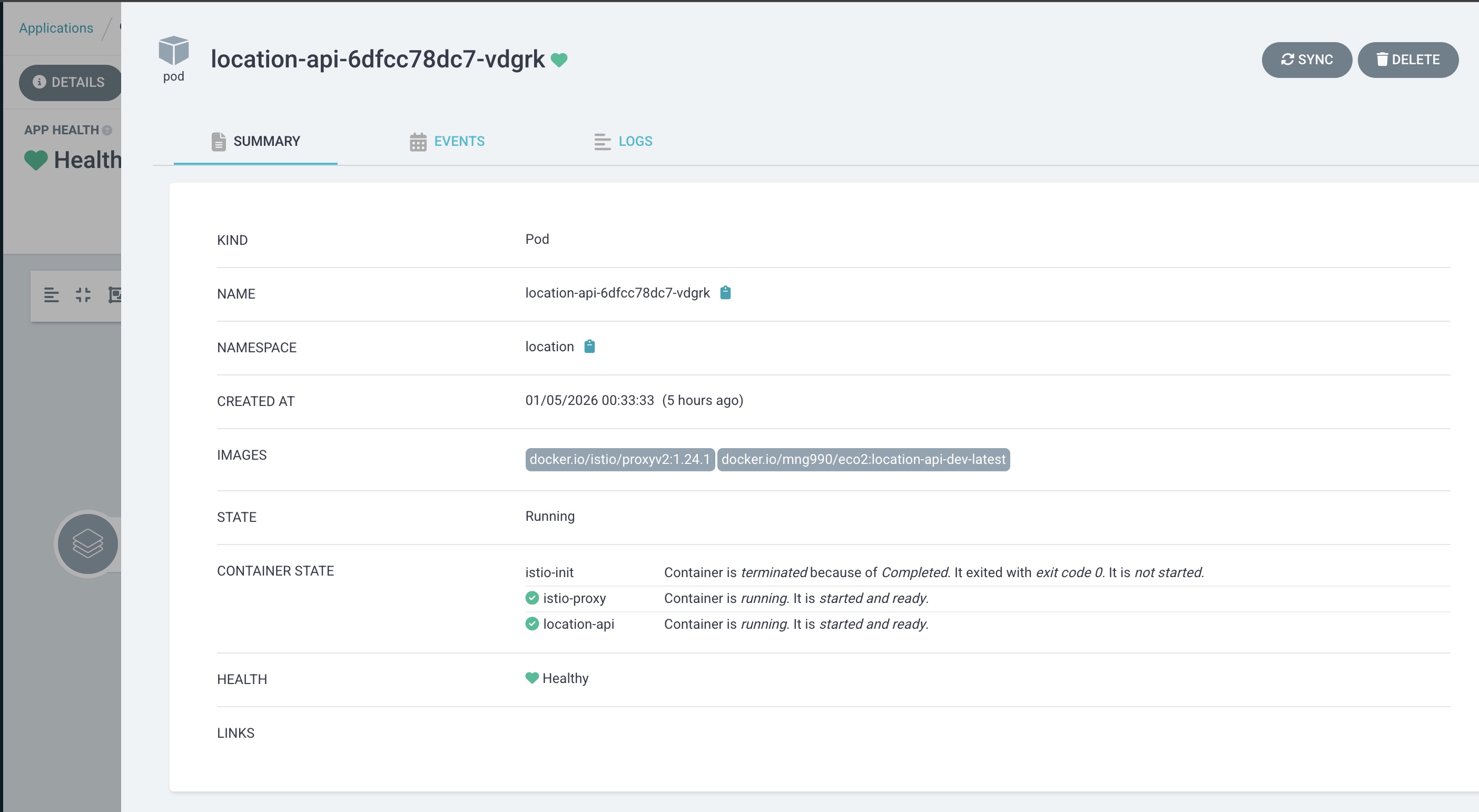
10. 배포 검증
# Pod 엔트리포인트 확인
$ kubectl exec -n location location-api-xxx -- cat /proc/1/cmdline
/usr/local/bin/python3.11 uvicorn apps.location.main:app --host 0.0.0.0 --port 8000

# 헬스 체크
$ kubectl exec -n location location-api-xxx -- python3 -c \
    "import urllib.request; print(urllib.request.urlopen('http://localhost:8000/health').read().decode())"
{"status":"healthy","service":"location-api"}

# 디렉토리 구조 확인
$ kubectl exec -n location location-api-xxx -- ls /app/apps/location/
application  domain  infrastructure  main.py  presentation  setup  tests
References
- Clean Architecture #11: Character 도메인 마이그레이션
- Clean Architecture #7~10: Application/Infrastructure/Presentation Layer 정제
- Local Cache Event Broadcast
- fastapi-clean-example
- Robert C. Martin, "Clean Architecture" (2017)
GitHub
GitHub - eco2-team/backend: 🌱 이코에코(Eco²) BE
🌱 이코에코(Eco²) BE. Contribute to eco2-team/backend development by creating an account on GitHub.
github.com
Service
이코에코
frontend.dev.growbin.app